When hunting becomes a female pursuit

Wenn Jagd weiblich wird
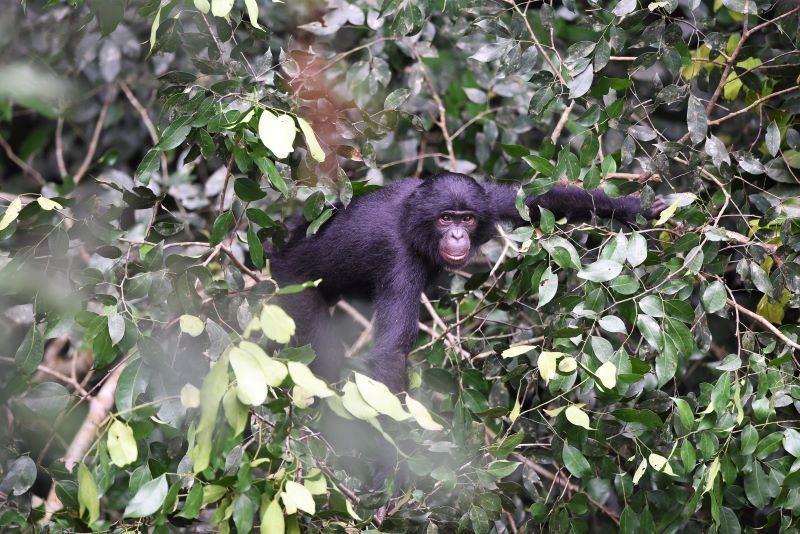
Nach unseren Standards sind Bonobos Flexitarier. Früchte, Blätter, Krautpflanzen und hin und wieder ein Stück Fleisch. Daran ändern auch die Ergebnisse einer aktuellen Studie zum Jagdverhalten von Bonobo nichts. Und dass die Bonobos im Wald von LuiKotale Waldantilopen und baumlebende Affen jagen war ebenfalls schon bekannt. Neu ist hingegen die dominierende Rolle, die Weibchen bei der Jagd spielen. Bei der Jagd auf Affen geht die Hälfte aller erfolgreichen Beutezüge auf das Konto von Jägerinnen und von vier Waldantilopen erbeuten sie drei. Das Bild vom jagenden Mann, der seine Sippe mit Fleisch versorgt, prägt bis heute die Vorstellung der Lebensweise unserer Vorfahren und scheint auf den ersten Blick auch plausibel. Tendieren Frauen nicht eher dazu, riskante Aktivitäten zu vermeiden und sind sie durch ihren Nachwuchs bei der Jagd nicht eingeschränkt? Bestätigung dafür, dass das hypothetische Szenario tief in der Evolution verwurzelt ist, kommt von Beobachtungen freilebender Schimpansen bei denen die Jagd tatsächlich reine Männersache ist. Und hat eine Schimpansenfrau auch mal einen Affen erbeutet, dann läuft sie Gefahr, dass ihr die Beute von einem Mann abgenommen wird bevor sie überhaupt mit dem Fleischverzehr beginnen kann. Nicht so bei Bonobos: Egal, ob es um Nahrung oder sozial Belange geht. Frauen behaupten sich gegen Männer und wenn der individuelle Dominanzstatus nicht ausreicht, dann tun sie sich eben zusammen. Entscheidend für die Motivation jagen zu gehen, ist also die Aussicht, die Beute gegen den Zugriff von Trittbrettfahrern verteidigen zu können. Am Ende läuft die Entscheidung, ob Sammeln oder Jagen, auf eine Kosten-Nutzen-Rechnung hinaus.
When hunting becomes a female pursuit
By human standards, bonobos are flexitarians. Fruit, leaves, herbaceous plants and, every now and then, a piece of meat. The findings of a recent study into bonobo hunting behaviour do nothing to change this. It was also already known that the bonobos in the LuiKotale forest hunt forest antelopes and tree-dwelling monkeys. What is new, however, is the dominant role that females play in hunting. When hunting monkeys, half of all successful hunts are carried out by female hunters, and of every four forest antelopes, they catch three. The image of the hunting man who provides his clan with meat still shapes our conception of our ancestors’ way of life to this day and, at first glance, seems plausible. Do women not tend to avoid risky activities, and are they not hampered in their hunting by their young? Evidence that this hypothetical scenario is deeply rooted in evolution comes from observations of wild chimpanzees, amongst whom hunting is indeed exclusively a male activity. And if a female chimpanzee does manage to catch a monkey, she runs the risk of a male taking the prey from her before she can even begin to eat the meat. This is not the case with bonobos: Whether the issue is food or social matters, females hold their own against males, and if their individual dominance status is insufficient, they simply join forces. The key motivation for going on a hunt is therefore the prospect of being able to defend the prey against freeloaders. Ultimately, the decision between foraging and hunting boils down to a cost-benefit analysis.
Neuer Text